a custom buckle, four apps to one
a hand-lettered Kufic design script, a sculpted centrepiece and a mesh CAD model become one castable belt buckle, then a film about replacing four apps with one canvas.
The brief: a custom belt buckle that no factory makes. Two linked ring shapes, lettering in square Kufic engraved into the metal, a sculpted centrepiece, and the back hardware a real buckle needs. It had to come out as one piece a caster could pour, in 18k gold, with a leather belt to show it on.
The same project then made a short film about its own method: four separate apps replaced by one canvas.
1 · the lettering is a script
The Kufic is not a font. It is a design script: a small program with parameters, living in a design node and drawing SVG. Its setting switch chooses square Kufic or a font; layout chooses block, pinwheel, border, rings, spiral or path, where the lettering follows a line you draw. A path layout can curve the letters, round its corners and leave holes. The node lists 26 presets, among them a band with medallions, a pinwheel for a buckle and a G as the path with the letters curved.
Change a value and the drawing redraws. Nothing is exported by hand, and the node keeps a link to the library design it came from.
2 · the ring shape
A second design node draws the ring shape as a single SVG path: an open circle with a bar across it. Its output is plain vector, so the 3D stage can read it by reference.
3 · a centrepiece
The centrepiece is a sculpture generated first as an image with Nano Banana Pro, then turned into a mesh with Tripo H3.1. The mesh arrives at 1.95 million triangles, which is too heavy to keep inside a live model. So the model uses a baked copy, repaired and thinned to 299 thousand triangles outside the chain, made once.
4 · the buckle
A 3D model node in mesh mode assembles the buckle from the pieces above:
- the ring shape is read from the design node and stroked into two bands, the second one the first turned 180 degrees so both openings face outward;
- the Kufic lettering is read from the script's output and engraved 0.6 mm into each band, a change made late when the first version had it raised;
- the baked centrepiece is imported, sized to the bands and cut flat at the back;
- a belt loop is one bent pipe, and a hook stud is a cone with a ball on its tip;
- everything is fused into a single body.
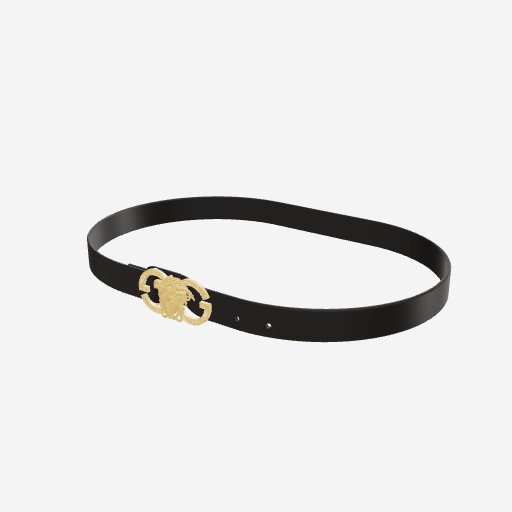
The model's notes record what was measured: 71.0 × 36.0 mm, 20.2 mm deep with the stud, a closed mesh with no open edges, about 107 g in 18k gold. The notes also keep the open questions, such as whether a caster can hold a 0.6 mm groove. Exports are STL, GLB and a render. A second mesh node models the leather belt.
5 · the films
The canvas holds four generations of the same film, from a first cut to a paper-collage version, each in several variants: hooks named for their lines ("No factory would make it", "3 shops, 3 cities", "How to, when you need one") and a fourth, "4 apps → 1 app". That one overlays four chips: AI for the mesh, AI for the SVG, a CAD app for the rings and loop, a mesh app to join the meshes. Then it shows the same work done on one canvas. The 9:16 cuts are made from Kling v3 Video clips, 3D animation of the model, and caption layers wired into video editor nodes.
what to borrow
- Make a design a script. Parameters, presets and SVG out: design scripts.
- Model from drawings by reference. mesh and sculpt and jewellery.
- Keep decisions in the model's notes. Measured numbers and open questions travel with the node: 3d overview.
- Make the film where the work is. animation studio and video editor.
- Draw small tools as code. live apps.
checked against the product · 2026-10-23