a clear-resin cassette player, case to score
a pocket player shaped like a cassette, with its resin case, three generations of circuit board, a camera deck and an assembly film, all as parametric models on one canvas.
The brief: a pocket player in the shape of a compact cassette, with a clear-resin case so the board shows through. It started as one standard model and grew into a family: a PRO version with a different processor, a second revision of that board, a clip-on camera deck and a programming board. The canvas holds all of them, and each part is built to fit its neighbour.
1 · the board and its case
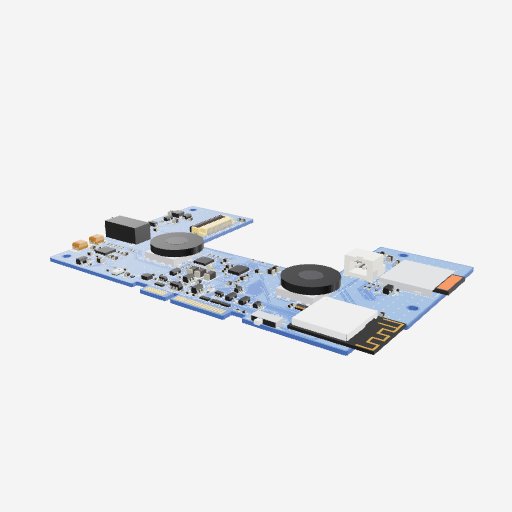
Everything starts with the main board: a 3D model node in electronics mode, labelled with its parts, an ESP32-S3, wireless charging, an e-paper display, audio and flash storage. It exports what a fab house asks for: Gerber, drill, BOM, CPL and a KiCad project, plus a 3D file and a picture.
The case is a second model, in CAD mode, that references the board's 3D file. That is the trick of the whole project. The case's notes record a stack of heights in millimetres: bottom plate, standoffs, board, then everything that rises above the board's top face, the deck switch, the slider, the dial caps, the e-paper. When the board's thickness changed from 0.8 to 1.0 mm, the notes record how the stack was re-based so the parts above the board kept their place.
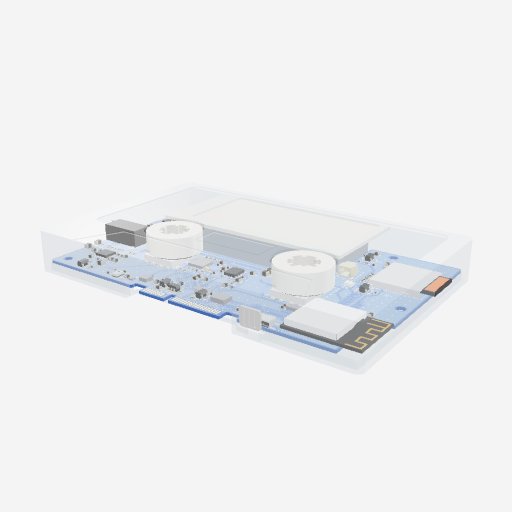
Case exports are STEP for CAD and a 3MF for printing.
2 · check that it fits
The case notes keep an interference log: which contacts are expected (the switch stand-in sits on its pads, a flat cable enters its connector) and which near-misses are 0.05 or 0.1 mm.
3 · the family
The next generation lives beside the first, not over it:
- ixi cassette PRO: a main board built around an ESP32-P4 and a C5, with its own case;
- PRO v2: the same board with USB-C and no wireless charging;
- camera deck: its own board and case;
- programming board: its own board, with its own exports;
- a pinout poster, an image composer node, for the deck slot.
Each is a node with the same exports, so a revision never overwrites what was ordered.
4 · assembly film
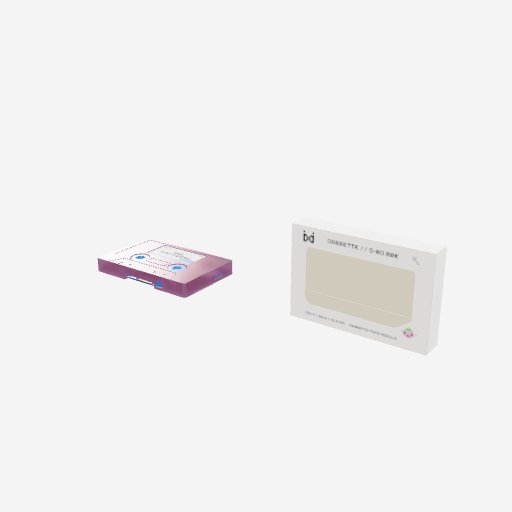
A model in animate mode renders the product's assembly to video and stills. The camera deck gets its own animation, labelled "clip on, land, 360". The picture below is from the assembly animation, with the cassette beside its retail box.
5 · the score
A text node holds the prompt for a 22.6-second tactile synth score. A Lyria 3 Pro node turns it into music for the camera deck sequence. Nano Banana Pro made one concept picture, an agent intercom, kept beside its prompt.
what to borrow
- Build parts that reference each other. A case that reads the board's file: assembly and motion and variants and checks.
- Treat electronics as a model. electronics.
- Export for the people who make it. STEP, 3MF and fab files: cad.
- Write the notes into the node. 3d overview.
- Score the film in the same place. animation studio and model nodes.
checked against the product · 2026-10-23